
Where do you start?
 When creating a Book of Shadows, it’s important to determine what format works best for you and your practice. Your Book of Shadows will change as much as you do, and its beneficial for your BoS to reflect who you are as much as who you were. To start creating a Book of Shadows for yourself (or even a new one), ask yourself some key questions:
- Would you prefer to work with something digital or write it out by hand?
- Will a binder work better than a notebook?
- What is your budget
- Does it need to be portable? Large? Small?
- What kind of layout would you like?
Some practitioners prefer the ease of keeping a digital copy as its less likely to get permanently damaged by a kitchen or candle accident. However, it also means that you will need to bring a computer or similar device into your circle when you do a ritual. This can be cumbersome and add extra clutter to a ritual, which can be distracting.
A binder or fillable journal is an excellent choice if its a first time BoS. Pages are easily moved from one section to the next as your BoS grows with your practice. Rituals and spells can also be edited and reprinted/rewritten to keep your book “up to date.” Its also useful if you want to include objects like dried herbs & flowers, sachets, drawings, gems etc with your rituals.
Before you start adding details to your book, decide how crafty you want to get. Do the pages need to look antique? Do you want to add banners, calligraphy, fabrics? What kind of colors do you want?
Fair warning, its easy to start your BoS convinced that its going to be a masterpiece. But remember, mistakes happen and you don’t want to get discouraged because your paper looks stained rather than antique. Most importantly, make sure that the book is something you can utilize. It is and will be an important tool in your practice.
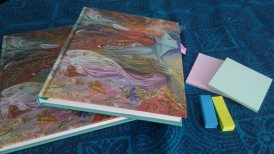 (In 17 years, I’ve started and utilized at least three Book of Shadows. The incarnation that lasted the longest was a 2″ purple binder. However, I also had some rituals and information in digital format on its own special thumb-drive. Neither of them are “me” anymore, which is why I’m currently working on my fourth version.)
What to include?
There is always a lot of discussion surrounding what should be “in” a practitioner’s BoS. The bottom line however is it is 100% up to you. Everyone else offers suggestions not absolutes. In that spirit, here are some of the items I include in my versions.
- Wheel of the Year: Sabbats, Esbats. List them.
Even after 17 years, there are times when my life gets busy enough that a Sabbat will pass before I realize it. Having them listed with any details that are important to you also makes it easy to list other things like rituals, affirmations, or recipes that particularly resonate.
When I was using the binder, I also included a section for “Next Year.” This is where I would put rituals, knowledge, or tasks I wanted to try when the Sabbat came around again. It helped give me options during the calendar year so practicing didn’t become stale. - Pantheons: List your gods and goddesses.
This is especially helpful if you are new to the craft. Listing the correct way to pronounce names (I’m looking at you, Celtic Gods) and any cultural associations helps to connect with the right deity for the occasion.
Since BoS don’t need to be all business, listing your favorite myths are an interesting way to bring personality to your book. It has the added benefit of clueing you in on which deities you feel particularly connected to. - Correspondence & Associations: I cannot recommend these enough. This section is quite broad as well, which is why I chose to do it as one batch rather than a dozen. Crystals, plants, elements, colors, candles, planets, moon phases all have associations to each other, to seasons, to Sabbats, etc. Including these associations into your BoS is a great reference whether you are cooking in the kitchen, playing in your garden, or crafting a new ritual.
*For example, Ostara.
*Ostara is associated with colors like light green, yellow, most pastel shades. Flowers like daffodils, honeysuckle, violets, tulips, and dandelions are particular prevalent during this Sabbat as its the first solar holiday of the year, and represents the emergence of Spring. Herbs include lemongrass, spearmint, catnip, even Ash trees… (You get the idea). - Are you a Green Witch? Me… not so much. I’ve had to learn how to keep plants alive over the years. (I mentioned before that I killed a cactus). I have however, documented the trials and tribulations of my Green Witchery.
Write down the knowledge you’ve gained on growing herbs, flowers and other plants. Do particular plants grow well together? What kind of insects and animal life will they attract? Including this information is a great start for a current or future garden.
Include tidbits on plant identification, drying guidelines and usage instructions. This will make crafting sachets or teas easier. You don’t want to put too much of a dangerous herb in a tea for instance. - Kitchen Witchery: I love to cook and try new recipes. I also have recipes specific to Sabbats like Samhain or Yule for instance. I keep these in my BoS rather than my cookbook simply due to the amount of ritual that accompanies the craft.
- Altar: I have more than one altar set up, especially at different times of the year. My altar is fullest during the Fall, before and after Samhain, as it is the season that resonates with my practice the most. For this reason, I’ve included details on altar tools and set up into my BoS. I’ve found that certain seasonal decor helps channel the energy of my altar more than others.
- Language: Do certain words or quotes have power for you? Remember that a BoS is a record of your personal journey. Include sigils, symbols, quotes, affirmations, or p
 owerful words. My BoS begins with the Capricorn symbol, although not the current symbol for the sign. I utilize the Roman version, when Capricorn was still represented as a water sign, the “Sea Goat.” The symbol reminds me to be strong even during the worst times in my life.
 - Magical Knowledge: This option isn’t for everyone. There are many practitioners who prefer not to put “another’s” research or knowledge into their BoS, which is perfectly fine. If you feel this way, I recommend having two notebooks: one personal BoS and one magic/research journal. This way you can make notes on rituals, chants, holiday recipes etc that you’d like to try in the future. If you do include knowledge or rituals from another author in your BoS, I highly recommend giving credit where credit is due. Be honest in your BoS.
- Personal Knowledge: Whether its a simply daily blessing or a Sabbat ritual, imbue your Book of Shadows with your personality and practice. Be sure to include the rituals you’ve designed through your own trial and error. Include your dedication, and the rules of your coven (or if you are a solitary, your own rules). Make charts, include herbs, beads, gems and fabrics
HAVE FUN. If you start thinking of your BoS as a chore, you’ll set it aside. You definitely don’t want to include those negative thoughts or energies into your book. Take a break and come back to it, especially if you are finding it frustrating. This book will be with you for a long time, so enjoy the journey.
Happy Crafting!
Blessed Be.
 Toil & Tomes