
So, you found Wicca. Perhaps you’ve gone out and purchased a few items. Attempted to build an altar or two?
Except, where do you go from there?
Which path do you choose? Gardnerian, Alexandrian, Dianic, Faerie, Georgian, Eclectic…
Wicca, like ‘Christianity,’ is simply an umbrella. There are many different sects, pantheons, and paths to choose from; which has the unfortunate tendency to make the sheer amount of materials concerning Wicca overwhelming.
I’ve been thinking recently just how rocky my start was down the Wiccan path. I found it really hard to start doing rituals, I second guessed the way I was practicing a lot. It took some time for me to find a rhythm and truly become comfortable in my own path. That being said, I still study, research, and change my rituals as I grow in my practice. Like many others, I have shelves upon shelves of books, but there are a few authors that I found handy when determining how I wanted to practice.
1 – Scott Cunningham
If you’ve been studying Wicca for 10 years or 10 seconds you have most likely come across Cunningham’s work. Cunningham was an interesting character. Despite studying creative writing in school, his approach to writing instruction books for solitary practitioners is reminiscent of many past anthropologists. He fully immersed himself in the field of study and wrote his books both as an observer and a practitioner.
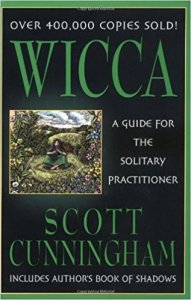 His book Wicca: A Guide for the Solitary Practitioner, published in 1988, still remains one of the top-selling Wiccan guides. All of his books lay out notions of practicing related to spell work, altar structure, color associations, the inclusion of cardinal directions, roles of the God and Goddess etc. I find that his guides are excellent places to build the foundation of your rituals. They are extremely detailed, and if you are unsure or confused, they provide structured rituals for practice.
Fair warning though: Cunningham is rather arrogant in the way he defines Wiccan worship. He has a “do this, not that” attitude, and does present his rituals as the only way to practice (which is not true). That being said, I highly recommend his encyclopedias on herbs, gemstones, aromatherapy and oils. They are worth the space on your shelves. (Goodreads has a pretty comprehensive list of his writings here: Cunningham)


2 – Deborah Blake (Check out her website here: Deborah Blake )
Blake is both a fiction and non-fiction author. (I’ll be honest, I haven’t gotten around to reading her fiction yet). But, I absolutely love her guides to Wicca. She is all about the free-form. Her guides are fun and interesting; you even get little snippets from her personal successes and failures. They are far easier to read than Cunningham’s guides, but as I stated they are far less structured and more “go with the flow.”
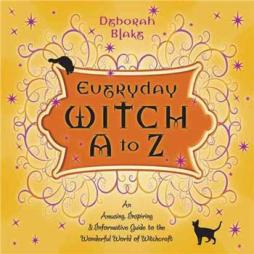
I’m particularly fond of her Everyday Witch series, as well as Witchcraft on a Shoestring (helping the everyday witch on a budget). In addition to providing lighthearted conversation (rather than the lecture style that is so common), the books are great for the basics or as a refresher for more experienced practitioners. Blake excels at innovation, helping to define magic as not just practical but fun. Practicing should never be boring, never mundane, and most importantly, never a chore.
Its very easy in the beginning to think that “you have to practice” at certain times; for every Sabbat, for every moon. In reality, this isn’t even remotely true. You can find meaningful ways to practice by simply rituals as much as the more traditional ones.
Some people will find her books to have too much “fluff.” Blake’s books are not research intensive, so there is very little elaboration or historical detail involved. Her books are designed for you to gravitate and find your own balance. She simply helps present some options to do so.
(Please keep in mind that Blake has a fiction “Everyday Witch” series as well, you definitely want to make sure you are looking at the guides)
3- Lisa Chamberlain ( Check out her website here: Lisa Chamberlain)

If you are talking basic research into Wicca, you can’t get much more basic than Chamberlain. The thing I love about her books is that they are filled with little historical tidbits into the roots of Wicca, but also delve into different pantheons and cultures. That being said, I would never consider her an authority on those cultures, but for the purposes of her writing it works. Her guides are short and to the point, and they run all over the place; Moon Magic, candles, elements, crystals, altar decorations, seasons, initiations, Deities, etc.
Her books cover everything, and are wonderful for beginner practitioners. They are especially useful if you are interested in a topic, but overwhelmed about where to start. I find that Chamberlain’s books are great “jumping off” guides. They give you the most common uses, names, and areas of Wiccan practice, but also provide interesting ways in which to incorporate these ideas into your path.
If you are interested, Amazon is running a deal on her e-books at the moment. The Kindle and e-reader editions are between $3 – $6, which (as I’m sure you all realize) is a much cheaper investment than the bookstore.
What’s Next?
I’d love to hear about other experiences and authors you’ve come across.
But, most importantly, happy reading!
 Toil & Tomes